What Does a Powertrain Warranty Cover?
By the Atlas team · Updated November 19, 2026
The short answer: A powertrain warranty covers the parts that make a car move: the engine, the transmission and the drive system (axles, driveshaft, differentials and, on AWD or 4x4 vehicles, the transfer case). It does not cover air conditioning, electrical systems, brakes, suspension or wear items. Most mainstream brands cover the powertrain for 5 years or 60,000 miles.
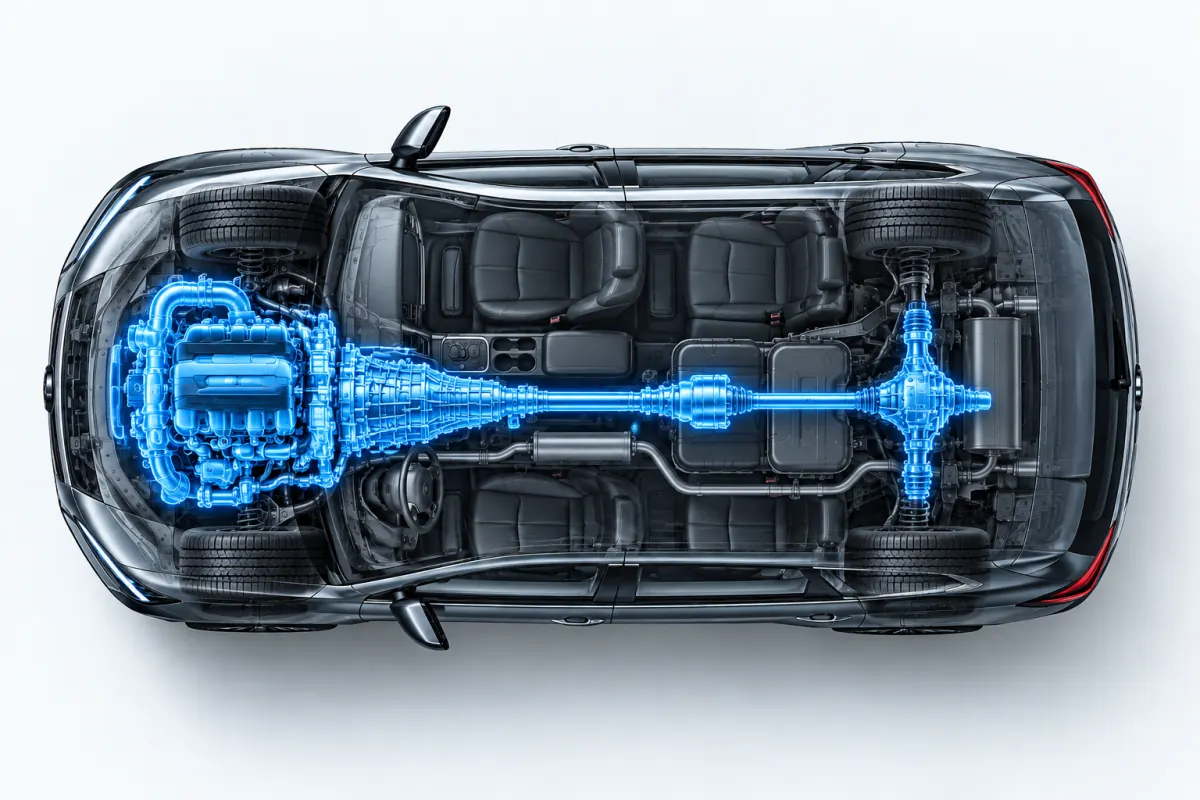
Is it part of the powertrain? Part by part
Here’s how most manufacturers treat the parts people ask about most. Your warranty booklet is the final word, because lists vary by brand.[1]
| Part | Covered by a powertrain warranty? | Why |
|---|---|---|
| Engine internals (pistons, crankshaft, valvetrain) | Yes | Core engine parts |
| Timing belt or chain | Usually yes | Internal engine part; some brands treat the belt as maintenance |
| Water pump and oil pump | Usually yes | Listed with the engine on most warranties |
| Turbocharger | Often yes | Covered when it's part of the engine; varies by brand |
| Transmission and torque converter | Yes | Core transmission parts |
| Axles, driveshaft, differentials, transfer case | Yes | They carry power to the wheels |
| Seals and gaskets (e.g. valve cover gasket) | Sometimes | Usually only when they're part of a covered part |
| Alternator | No | Electrical (charging) part |
| Starter | No | Electrical part |
| Electrical systems and sensors | No | Not part of moving the car |
| Engine computer (ECM/PCM) | Usually no | An electronic module; a few brands include it, so check your booklet |
| Air conditioning (compressor, condenser) | No | Climate system |
| Suspension and shocks | No | Not part of the powertrain |
| Power steering and steering rack | No | Steering system |
| Brakes and ABS | No | Brake system |
| Catalytic converter | No | Exhaust and emissions part |
Need coverage for the parts a powertrain warranty leaves out? See how Atlas plans fit in.
What is a powertrain warranty?
A powertrain warranty is the manufacturer’s promise to repair defects in the parts that create power and send it to the wheels. It comes with a new car at no extra cost and usually lasts longer than the bumper-to-bumper warranty, which covers most of the rest of the car.
The name tells you the scope: power (the engine) plus train (everything that carries that power to the road). If a part isn’t involved in moving the car, a powertrain warranty almost certainly doesn’t cover it.[1][2]
What a powertrain warranty covers
Exact lists vary by manufacturer, so your warranty booklet is the final word. In general:[1]
| System | Typically covered |
|---|---|
| Engine | Cylinder block and heads, internal parts such as pistons, crankshaft and valvetrain, timing belt or chain, oil and water pumps |
| Transmission | Case and internal parts, torque converter, on automatic, manual and CVT transmissions |
| Drive system | Driveshaft, axles and axle shafts, differentials, bearings |
| AWD / 4x4 | Transfer case and its internal parts |
| Seals and gaskets | Often covered when they’re part of a covered component |
What a powertrain warranty doesn’t cover
This is where most surprises happen. A powertrain warranty generally does not cover:[1][3]
- Air conditioning and heating (compressor, condenser)
- Electrical and electronics (alternator, starter, sensors, infotainment, power windows)
- Steering, suspension and brakes
- Wear items (spark plugs, filters, fluids, brake pads, clutch, wipers, tires)
- Damage from accidents, neglect, misuse, aftermarket parts or contaminated fuel
- Repairs after missed maintenance, if the manufacturer can show it caused the failure
Some of these are among the costlier repairs on a modern car, such as an A/C compressor, an alternator or an engine computer, and none of them are powertrain parts. See the part-by-part table for alternators, starters, A/C, suspension and more.
How long does a powertrain warranty last?
Most mainstream brands cover the powertrain for 5 years or 60,000 miles, whichever comes first. A few go longer:[1][4]
| Brand | Powertrain term |
|---|---|
| Ford, Chevrolet, GMC, Ram, Jeep | 5 years / 60,000 miles |
| Toyota, Honda, Nissan, Subaru | 5 years / 60,000 miles |
| Hyundai, Kia, Genesis, Mitsubishi | 10 years / 100,000 miles |
Read the fine print on the 10-year warranties. Hyundai’s 10-year/100,000-mile powertrain coverage applies only to the original owner. If you bought the car used, it’s 5 years/60,000 miles from the original in-service date.[4][5] Kia and Genesis apply similar original-owner rules, so check your booklet.[4]
Terms change by model year. Always check the warranty booklet for your exact vehicle.
Powertrain vs. bumper-to-bumper warranty
| Powertrain warranty | Bumper-to-bumper warranty | |
|---|---|---|
| What it covers | Engine, transmission, drive system | Most factory parts, including electrical, A/C, steering and suspension |
| Typical term | 5 years / 60,000 miles | Often 3 years / 36,000 miles (varies by brand) |
| What it doesn’t cover | Everything that isn’t the powertrain | Wear items, maintenance, damage |
So for most drivers there’s a gap: from about year 3 to year 5, only the powertrain is covered. After year 5 or 60,000 miles, nothing is.[1] See what a bumper-to-bumper warranty covers for the other half of the picture.
“Lifetime” and “limited” powertrain warranties
A limited powertrain warranty is just the standard kind: limited to certain parts and a set time or mileage. Nearly every factory warranty is “limited”.
A lifetime powertrain warranty is usually a dealer promotion, not a manufacturer warranty. These often require you to service the car at that dealer on a strict schedule, and missing one visit can end the coverage. Read the terms before you count on one.[1]
What happens when your powertrain warranty ends?
Once the factory warranty ends, you pay for every repair yourself, including the big ones like a transmission (see what a transmission repair costs). For more, see what happens when your warranty ends.
You have three options:
- Self-insure. Set aside money for repairs each month and pay as things break.
- Buy the manufacturer’s extended plan, if it’s still available for your car’s age and mileage.
- Choose a vehicle service contract from an independent company. These pay for covered repairs after the factory warranty ends. Here’s what affects the cost of a service contract.
The FTC recommends checking a few things before buying any service contract: who administers it, what’s excluded, the deductible, which shops you can use and how claims work.[3]
How Atlas plans fit in
Atlas sells vehicle service contracts that pick up where the factory warranty leaves off. Atlas plans pay for the parts and labor on covered breakdowns, so one big repair doesn’t wreck your budget. Extend your coverage after your factory warranty ends and save thousands on expensive parts and labor.
- Powertrain Choice is built for older or high-mileage cars, and goes past a factory powertrain warranty. The Powertrain Choice plan focuses on the vehicle's most vital mechanical parts, the engine, transmission and drivetrain, and adds core cooling, A/C, fuel and electrical components. Unlike a factory powertrain warranty, Powertrain Choice adds core cooling, A/C, fuel and electrical components. Coverage varies by plan; see the sample contract for the exact list and exclusions.
- Exclusive, Deluxe and Essential Plus cover more systems still, depending on the plan.
- Every plan includes 24/7 roadside, rental car (up to $50 a day, $350 max) and trip interruption (up to $75 a day for 3 days, 100+ miles from home). Limits apply.
- Flexible deductibles from $0.* Use any ASE-certified shop or your dealer.
*With a $0 deductible on covered repairs. Coverage varies by plan; see your contract for terms and exclusions. Atlas sells vehicle service contracts, which are not manufacturer warranties or insurance.
Powertrain warranty FAQs
Is the transmission part of the powertrain warranty?
Yes. The transmission and its internal parts, including the torque converter, are core powertrain parts on every mainstream warranty.[1]
Does a powertrain warranty cover electrical problems?
No. Electrical parts such as the alternator, starter, sensors, wiring and infotainment aren't part of the powertrain. A bumper-to-bumper warranty or a vehicle service contract can cover them.
Is the alternator part of the powertrain?
No. The alternator charges the battery and powers the electrical system, so it’s an electrical part, not a powertrain part. See what an alternator replacement costs.
Is the starter covered under a powertrain warranty?
No. The starter is an electrical part.
Is suspension covered under a powertrain warranty?
No. Shocks, struts, control arms and other suspension parts aren't part of the powertrain.
Is A/C covered under a powertrain warranty?
No. The A/C compressor, condenser and the rest of the climate system aren't powertrain parts.
Does a powertrain warranty cover the turbocharger?
Often yes when the turbo is part of the engine, but it varies by manufacturer. Check your booklet.
Does a powertrain warranty cover the water pump?
Usually yes. Most manufacturers list the water pump with the engine. See what a water pump replacement costs.
Is the engine computer (ECM) covered under a powertrain warranty?
Usually not. It's an electronic module, though a few brands include it. Check your booklet.
What parts are excluded from a powertrain-only extended warranty?
Usually the same parts a factory powertrain warranty excludes: A/C, electrical, steering, suspension, brakes and wear items. Each contract lists its own exclusions, so read the sample contract before you buy.
What is a "limited" powertrain warranty?
"Limited" means the warranty covers only the parts and conditions it lists, usually with a time and mileage cap. It isn't a weaker type of warranty; it's how almost every warranty is written.
Does a powertrain warranty transfer to a new owner?
Most do, for the rest of the original term. Some 10-year warranties drop to 5 years/60,000 miles for later owners.[5]
Can missed oil changes void a powertrain warranty?
They can lead to a denied repair if the manufacturer shows the missed maintenance caused the failure. Keep your service records.
Can I get powertrain coverage after the factory warranty ends?
Yes. A vehicle service contract can cover the engine and transmission after the factory warranty expires, subject to the vehicle’s age, mileage and the plan’s terms.
Still have questions? Call 888-600-8084.
Sources
- Kelley Blue Book, “Quick Facts About Powertrain Warranties,” updated December 9, 2025. https://www.kbb.com/car-advice/powertrain-warranty
- Ford, “What parts are covered by the Ford Powertrain Warranty?,” accessed November 12, 2026. https://www.ford.com/support/how-tos/warranty/warranties-and-coverage/what-parts-are-covered-by-the-powertrain-warranty/
- Federal Trade Commission, “Auto Warranties and Auto Service Contracts,” last modified June 30, 2026. https://consumer.ftc.gov/articles/auto-warranties-and-auto-service-contracts
- Motor1, “Every Automaker Warranty Ranked From Best To Worst,” accessed November 12, 2026. https://www.motor1.com/features/253277/comparing-new-vehicle-warranties/
- CarWhere, “Hyundai Warranty: Powertrain, New Vehicle, EV Battery and Transfer Rules,” updated November 5, 2026. https://www.carwhere.com/hyundai/warranty